

Today is National Voter Registration Day in the United States, and there is good news from Vote.org. As of September 13, the organization has helped register 348,000 voters, making 2026 its strongest midterm year on record, with voter registration 57% ahead of this same moment of the 2022 midterm cycle. Vote.org has registered a total of 10 million voters in its history, more than any other voter registration organization in the country.
Yesterday we got the news that the Supreme Court has allowed a federal court injunction to stand that blocked a U.S. Postal Service rule from enforcing Trump’s executive order.
Predictably, the two far-right operatives on the court dissented. One of them —not the one who has accepted luxury gifts from a billionaire with statues of dictators in his garden, but the other one, who flew an insurrectionist flag from both his homes —used his dissent statement to repeat the Trump Party Line about needing to “better detect election fraud.” The majority of the court did not see a convincing case for voter fraud, and so for the moment vote by mail remains in place.
All of this makes our conversation with election lawyer Tyler Hagenbuch more timely.
Normally these conversations are only for paying subscribers, but I want everyone to have the benefit of this one. It gives you a sense of how these live discussions unfold. So here it is. If you prefer to read, an edited transcript is below.
If you’d like to participate in these weekly gatherings, ask questions live, and have access to the full archive of Lucid conversations, you can upgrade to paid or sign up as paying here. In honor of voter registration day, here is a coupon for 30% off for the first year. It is good until Friday night.
___________
Ruth Ben-Ghiat: I’m very happy to have with us Tyler Hagenbuch, who is an election attorney and a strategic consultant. He serves as senior advisor to a nonpartisan coalition of state and national partners who focus on identifying, preparing for, and responding to threats of election subversion and election sabotage. He’s been a partner at Perkins Cole Political Law Group and also at the Elias Law Group. And his writing on election law and civic engagement has appeared in Fortune, The Hill, Bloomberg Law, and other places. So welcome, Tyler.
Tyler Hagenbuch: Thank you so much for having me. Good morning for me to everybody. Good afternoon, good evening, wherever you are.
Ruth: I thought we could start by thinking about what mail-in voting means for people, and what the stakes are of the attempts to block it, even if these attempts have not been successful.
Tyler: I think the stakes are really personal. They’re really personal for communities that are struggling right now. They’re really personal for voters who feel a sense of patriotism or pride or resistance in casting their vote. So that’s where it starts. This is a really personal attack that is coming on mail-in voting relentlessly, like you said. And if the attack is personal and silences people’s voices, it silences their ability to protect their community with their vote, to protect our democracy with their vote.
Ruth: Just to review, up to 30% of Americans, nearly 47 million people, voted by mail in 2024. It’s interesting that you mentioned silencing, because I always say that your vote is your voice. And it’s such a moving thing to be able to vote and decide who represents us. We decide who sits in Congress and who makes laws that are supposed to represent our interests and desires.
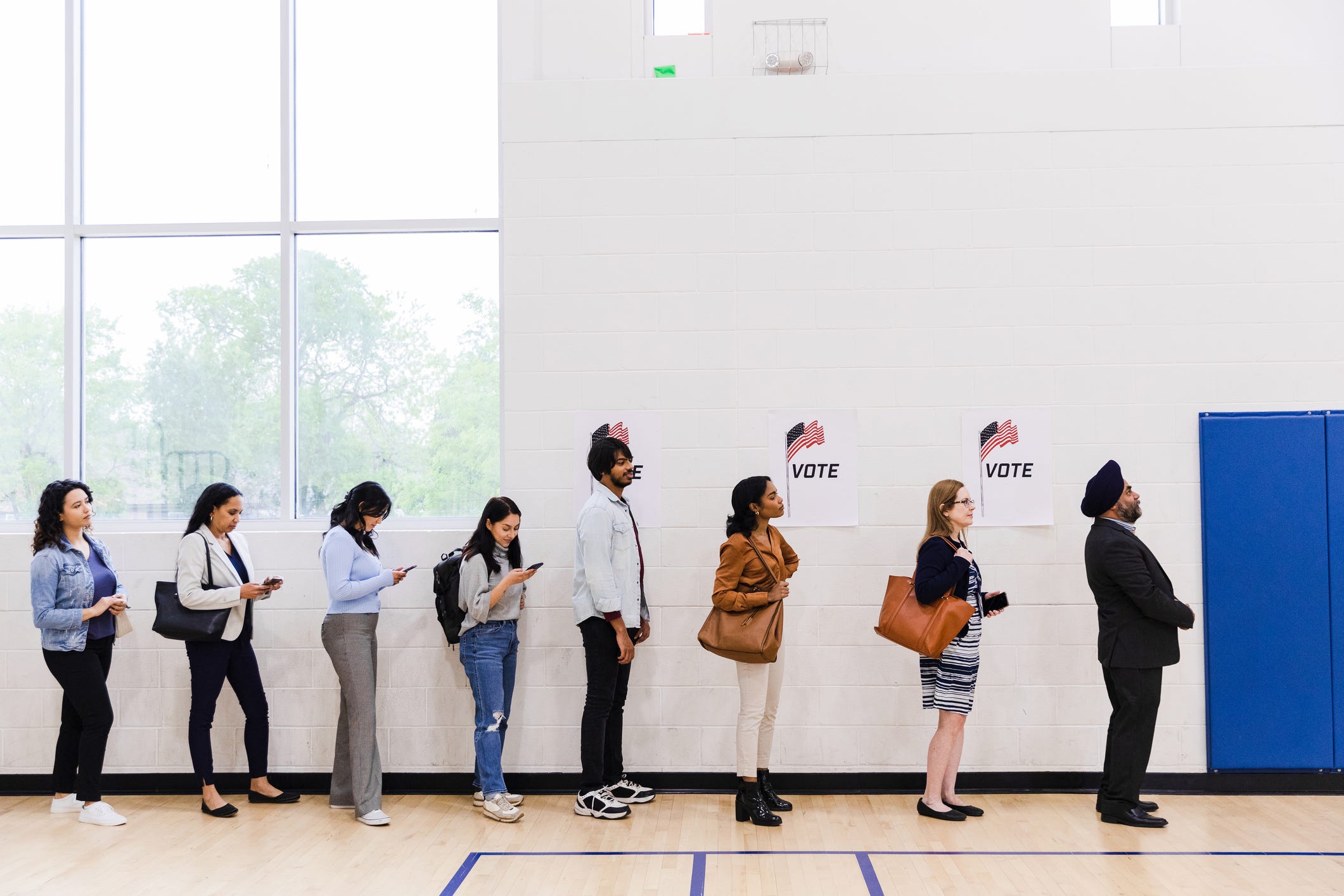
Authoritarians do their best to silence that voice, in part by creating confusion around voting and by delegitimizing elections. But they’re really trying to make us self-silence.
You can think about not voting as not just an abdication of civic duty, but a form of self-silencing. If your vote is your voice, and your voice can change history, not voting, or becoming cynical about voting, whatever the cause is, not doing it is a form of self-censorship.
Tyler: Well, they’re terrified of us. And that’s why they’re doing this, right? They are terrified of the system that we live in under our Constitution that says in this country, voters get to pick their leaders. It is not the case that leaders get to change the law and pick who votes for them or how they vote. So they’re absolutely trying to make us feel hopeless and helpless and lost and confused. So we do exactly what you said, stay home and self-silence.
Ruth: Can you talk about the confusion issue? Because we’re 10 years into this strategy. Trump started campaigning in 2016 and talking about corruption around elections. We know intellectually that he was trying to delegitimize the whole idea of voting, and cast doubt on our safe and secure election process. How do we counter that?
Tyler: Yeah, I’d really be happy to. I’ve got a couple of points. The first is that their confusion plan is a plan, it’s a playbook that they run in country after country. It’s sort of a two-pronged attack meant to confuse us. One is we get confused and overwhelmed, and we think, you know what, maybe I don’t trust this system, that my vote’s not going to count, it’s not going to be counted, it’s too much to figure out, I’m just not going to vote, I’m going to self-silence. I really like the way that you put that.
The second aim is to drive down turnout, it’s to drive down participation. The other piece of it is even if everybody participates, even if things go well, we get attempts after to make us confused and not trust the results of the election.
We have evidence of this in the post-2020 election atmosphere, where Trump filed 65 lawsuits trying to overturn the results of the election and then organized mass political violence at the Capitol to try to stop it. And he was able to get that far because he had sowed that confusion, because he had got enough people to buy into the big lie that, hey, maybe there is something wrong here. So the confusion is both to suppress and to undermine the whole system.
I want to say a couple of things about countering that. One is that consistency is the opposite of confusion. We stay consistent on our message. And if we stay consistent on our message over and over and over, that’s going to build trust with voters who are hearing that message. And it’s going to calm them down because they keep hearing the same thing. And so that consistency is really important.
Another thing is that if we want people to do something on behalf of democracy, we have to make them to feel something. People cheer for their team because they feel hometown pride. People buy a concert ticket because that music makes them feel good or they feel community when they’re in that crowd. So what do we want people to feel if the thing we want them to do is to vote or to vote early or to vote using a drop box?
I would suggest that they need to feel, in this moment, defiance and determination. You can’t stop us. You can’t stop me from exercising my voice. So bringing it all back together, if that’s what you want them to feel is defiance and termination, you can’t stop me is the message. I’m going to vote.
And we have to make people understand why this is happening to them. It is the product of one man’s vendetta to confuse them, because of one administration’s relentless attacks. This is part of a plan. They do not want certain people to be able to vote and they do not want certain people’s votes counted. That is why this is happening.
It’s not coming out of the vacuum. It’s not coming out of nowhere. It is part of an autocrat’s playbook. If you tell them why it’s happening and make them feel defiant against it happening to them, then they’ll vote. That is my playbook for how we cut through the confusion.
Ruth: That not only makes sense in the current moment, it upholds a lot of the things I’ve learned about the history of getting people to mobilize for elections. Without that sense of emotional involvement, it doesn’t hold.
But what Tyler’s saying is, in order to keep people doing things over the long run, which takes discipline and some sacrifice, they have to be emotionally invested. Thinking about where we are now with these imminent threats, I couldn’t agree more.
Speaking of lessening confusion, I have this anti-disinformation strategy which I call expose the device. If someone’s spewing some piece of disinformation, you step back and you expose the larger goal or principle behind it. You don’t just try and refute the disinformation because it becomes the tit-for-tat thing.
An example was when Senator Jon Ossoff was interviewing Jay Clayton, then the nominee for Director of National Intelligence, and Clayton was refusing to answer the question of who won the 2020 election. Ossoff said:
“You refuse to answer a basic question about who won a presidential election, but you asked to lead America’s Intelligence Community. Isn’t it humiliating to be unable to answer this question, to have to indulge the president’s delusions? We know, you know, everybody in this room knows the truthful answer to that question. Why can you not give it?”
He talked about why the lie was being perpetrated, rather than trying to refute the lie. He exposed the device behind this election denial: loyalty to Trump.
Tyler, your point about consistency of messaging is so important because that there’s been a massive attempt to destroy trust in authorities, to destroy trust in institutions, and of course election denial is part of this. Consistency is how you start to rebuild that trust.
I am optimist, but I got discouraged recently about the numbers of people who did not vote in 2024. According to the Environmental Voter Project, 11.2 million people who are climate conscious did not vote in 2024.
On the other hand, Vote.org has been recording record numbers of registrations for the first quarters of the year. Where do we stand now on this?
Tyler: Those numbers about record registration are great because those are particularly young people. That platform registers more 18-year-olds than any other single source in the country. That’s great. What we have to do, what our challenge is for all of us, is making meaning out of the situation for the people who do register.
I think the mistake that we sometimes make, through our own good intentions, is that the first thing we ask them to do is to register to vote. What if the first conversation was, how do you feel about how things are going right now? What’s the biggest problem in your life? What are your challenges? Having a conversation, listening to them. Then further on down the line, maybe the second or the third or the fourth time we talk to them, we say, have you ever considered registering to vote? Voting is a way of making your voice heard and fixing your problems.
We don’t have that broader conversation. We also need to get better about meeting people where they already are. It strikes me that most Americans right now, certainly not us here, but most Americans aren’t participants in democracy.
They’re spectators of it, or even consumers of it. If we want to get them to do the thing, to vote, to participate in democracy, we need to zoom out a little bit and meet them at their farmer’s market, or their yoga class, or the game or the race.
Again, talk to them about the things they’re thinking about every day on the way to a conversation about voting. I think there’s good signs in the data, particularly with younger people staying engaged.
I’m in California, and I’m not sure I’ve been so surprised by a political moment in my life as last fall when we had Prop 50, and all of a sudden the polls are closing at the end of the night, and we’ve got college kids in line, and we’re a vote-by-mail state. They really turned out to vote in person with their communities. It meant something to them.
That’s our challenge, to engage the people who are registering, but then to also figure out how to have a broader conversation about community and civics and the connection between those things before we just say, hey, you should be a voter.
Ruth: Yeah, that makes a lot of sense. We can get way more creative about how we reach people. I remember reading that Sherrod Brown, when he was an Ohio Senator, did a deal with McDonald’s so that every time they served a Happy Meal, there would be a voter registration form on the tray. I thought that was fabulous.
Tyler: It’s incredible. It shows you how businesses can get involved. If businesses can get involved, then faith leaders can get involved. If faith leaders can get involved, then veterans can get involved. There’s an on-ramp for everybody. I really believe that.
Ruth: I guess the state example is good because when I read about some of the countries that had successes, like Chile, we’re just such a big nation in comparison, and we also don’t have a multi-party system. There are structural things and geographic things that can be a liability, but the amount of local identification, states’ rights, we do have, are benefits.
Tyler: You mentioned Chile, and it is my absolute favorite example of a pro-democracy movement forcing a U-turn from authoritarianism. This campaign, if folks haven’t seen the Chile No campaign when they turned back Pinochet, you just have to spend some time on YouTube learning about it. There’s an incredible music video that took over the country. What I take from Chile is that joy is a strategy. This campaign of how they were going to oust Pinochet and the absolute horrors that were being committed in that country for decades and then they messaged about positivity and joy.
It was essentially, think how great we’re all going to feel and how we’ll all be in community together once we’re past this moment. It brought people together. It made them feel something. It motivated them. It kept them sustained. It also made it very difficult for the autocrat to attack that campaign because it was the most nonviolent campaign. Their logo was literally a rainbow. I love that campaign. I really recommend people spend time learning about it.
Ruth: Yeah. For those who have Strongmen, this campaign is in the book. I also wrote a piece for the Atlantic in 2022 on it.
You know, Kamala Harris didn’t have much time to develop her campaign, but she had a theme of joy. Remember those stadiums filled to capacity with people dancing and an atmosphere of such positivity? We didn’t have enough time to develop it properly.
If the Trump campaign was a rehearsal for autocracy in many way, the Harris campaign modeled formulas for protecting and advancing our multiracial democracy. I know it is painful to think that we almost won, and could have avoided the nightmare we are living through, but we should return to those elements that were so promising as we work for our own U-turn from autocracy.
Thank you so much, Tyler, and thank you to everyone for being here today.
Thank you for having me! What a great community.
Yes, register to vote. Our democracy is not a spectator sport, it needs participation.
'How Will History Judge Us' [Full Speech 14-min] #Nature'sLastDance @nataliekyriacou
https://substack.com/@nataliekyriacou/note/p-213232930?utm_source=notes-share-action&r=kxzps