
When a Tyrant Becomes Vulnerable
An excerpt from Marcel Dirsus, How Tyrants Fall: And How Nations Survive

Today we are continuing our exploration of forms of “autocratic backfire” with Lucid’s first guest post, by political scientist Marcel Dirsus, author of the highly recommended book How Tyrants Fall: And How Nations Survive. The essay below is an excerpt from that book, which Marcel Dirsus has prepared exclusively for Lucid.

In 2024, for the anniversary of the deaths of Benito Mussolini and Adolf Hitler (the former shot by Italian partisans, and the latter killed by his own hand), I wrote these essays on how Fascists fall.


Marcel Dirsus brings us into the 21st century, telling the story of Libyan dictator Muammar Gaddafi, who lasted 42 years in power and created a formidable kleptocracy, becoming one of the richest men in the world. And yet, as Dirsus highlights in this essay, he could not escape the dictator’s trap of living in fear of everyone around him.
_____________
When most people think of tyrants, they conjure images of a man (and it is almost always a man) who wields absolute power. That is a myth. No political leader has ever had absolute power. Even the most powerful dictators need others in order to stay in power. To remain on their pedestal, they need to manage those closest to them. If they don’t, they are at immediate risk.
According to a recent study that examined the way 2,790 national rulers lost power, 1,925 (69 per cent) were just fine after leaving office. “Only” about 23 per cent of them were exiled, imprisoned or killed. But that was across all countries and political systems. Zoom in on the personalist dictators – the leaders with most power concentrated in their hands – and the numbers are reversed: 69 per cent of those tyrants are thrown into jail, forced to live their life abroad or killed. The odds for a tranquil retirement are worse than the flip of a coin.
The central problem that tyrants face is that eliminating the many immediate threats to their position can be costly and creates a never-ending cycle of new problems. Eventually, the tyrant may fall. And when that happens, it’s not just the tyrant who is at risk, because entire countries can crumble under the weight of a falling dictator.
That’s why even the most powerful tyrants on earth are condemned to live their life in fear. They can make their enemies disappear with a snap of their fingers. They, their families and their acolytes may control entire countries from the luxury of their palace, but they also have to spend their every waking hour plagued by the fear of losing everything. No matter how powerful they become, they cannot pay for or order that fear to disappear. If such tyrants make one wrong move, they will fall. And when tyrants fall, they often land up in exile, in a jail cell, or under the ground.
That’s what happened to Libyan dictator Muammar Gaddafi.
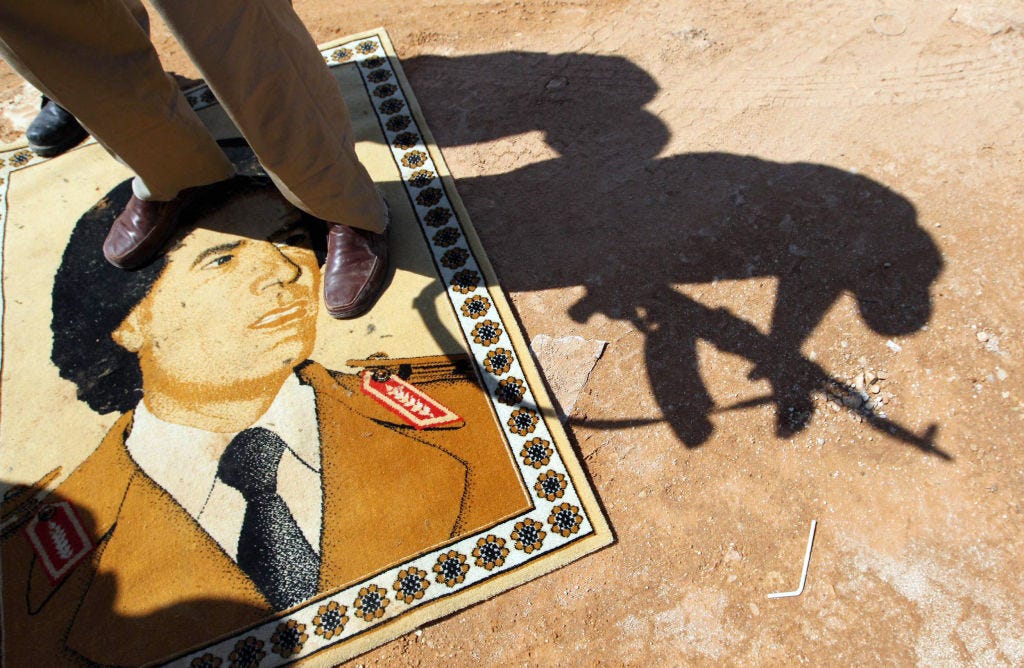
Even at the height of his power, with many of his enemies rotting underground or in prisons, Gaddafi saw threats all around. The walls around his main compound were four meters high and one meter thick. Underneath the compound, Gaddafi had his men construct a network of tunnels so vast that a golf cart was used to move around within it. The tunnels served as a means of escape and also contained an underground television station to allow the dictator to address his people while under siege.
In October 2011, with the regime severely diminished and bombs falling from above, Gaddafi knew the moment he had long feared had arrived. There were no more compounds, no more tunnels, no more walls that could protect the dictator. Instead, Gaddafi and his men moved from house to house in Sirte, the coastal town near which the dictator had been born. Supplies were limited and his bodyguards were forced to scrounge around to find pasta and rice to feed the group.
Gaddafi himself was clearly confused. “Why is there no water? Why is there no electricity?” he would ask the head of his guard. Trying to flee was risky, but with the rebels so close and the shelling constant, staying in Sirte was not an option.
Eventually, a reluctant Gaddafi agreed to escape. Originally scheduled to leave at 3 a.m., under the cover of darkness, his convoy of around forty cars didn’t leave until five hours later. By that time, the sun was up. Half an hour after the convoy left, it was struck by missiles. One of the explosions was so close that the airbag deployed in the Toyota Land Cruiser in which Gaddafi was travelling. The leader and a few of his men decided to flee on foot. After making their way across a farm, they had no option other than to hide in a foul-smelling drain.
When rebels grabbed him, he was unable to compute what was happening. He was Colonel Muammar Gaddafi, the Godfather of Libya, King of Kings of Africa. And, as he once described himself: the Leader Who Lived in All Libyans’ Hearts. “What’s this? What’s this, my sons? What are you doing?” Gaddafi asked. His “sons” proceeded to brutalise him. Beaten by the mob and sodomized with a bayonet, the last footage of Gaddafi shows him on top of a car, his head bloodied, asking for mercy.
With the dictator finally under their control, the rebels celebrated. In one of the defining images of the conflict, a young rebel was seen being carried on his comrades’ shoulders, holding a golden gun decorated with intricate engravings. That gun belonged to Gaddafi himself, supposedly given to him by one of his sons.
This is what I call the Golden Gun paradox: tyrants can have all the trappings of power, even a gun made of gold, but at the point where they need to use their power to save themselves, it is already too late. A dictator can never save himself with a golden gun. For Gaddafi, holding the gun only imbued power as long as people believed it did. The moment they stopped, the gun was useless.
By the end of that day, October 20, 2011, the gun was gone and the dictator was dead. As a final indignity, Gaddafi wasn’t afforded the quick burial that is customary in Islam. Instead, his topless corpse was displayed in the meat locker of a local shopping mall for all to see. When a journalist talked to a local man about it, he responded that Gaddafi had chosen his own destiny. “If he had been a good man, we would have buried him,” he said.
Ruth, this is one of your most powerful posts. Thank you, thank you, thank you! I am so grateful to you for sharing.
We can only hope that karma comes to this administration.