

Today’s essay is about how President Donald Trump and his MAGA accomplices use violent acts, speech, and spectacles to politically and emotionally re-educate Americans and transform institutions into vehicles of his authoritarian goals. I also look at Libyan leader Gaddafi’s use of television as an example drawn from classic dictatorship.
Here is a takeaway relating to Trump’s present situation:
As his popularity decreases, making him feel desperate and impotent, Trump’s desire to “make his mark” on history with a grand violent gesture increases. This is why he is now speaking about annihilating Iran, and has floated the idea that entire cities in California, which has a Democratic governor, could be destroyed. “They can take out a city,” Trump stated, referring to Iran. “Let them take out Los Angeles. Let them take out San Diego.”
This is the “trial balloon,” which rehearses extreme ideas related to the autocrat’s vision of violence as a means of changing history. I hope you will read it and share it with others.
_____________
“Donald Trump is a disturbed individual with a strong penchant for violence,” wrote Bess Levin in a February 2023 Vanity Fair report on Trump’s desire to “bring back firing squads and hangings in his second term, is thinking about guillotines too.” That same month, Rolling Stone reported that a former White House official stated that Trump “had a particular affinity for the firing squad because it seemed more dramatic” than lethal injection and would lend itself to “a flashy, government-backed video-ad campaign that would accompany a federal revival of these execution methods.”
Now he is in a position to realize his dream, with the help of like-minded enablers who appreciate a good bloodfest and the power of visuals to attract and influence people. These include Secretary of Defense Pete Hegseth, a former Fox News Business on-air host with an apparent fixation with “lethality.” Hegseth announced that the execution of former Army psychiatrist Nidal Hasan, who killed 13 and wounded 23 at Ford Hood, Texas, in 2009, would be carried out by a firing squad and livestreamed to the public.
Livestreaming a Government Execution: a “Trial Balloon”
Axios reports that Trump is having second thoughts about the livestream, after receiving negative feedback from politicians and advisors. Yet Trump rarely listens to or cares about negative feedback, nor is he ever really concerned about the legality of this or other administration proposals. If he declines to go through with the livestream, it will be because he has already achieved the most important thing: giving an extremist idea validity by having it discussed within government and in the public sphere.
Using such “trial balloons” to radicalize Americans, inculcating hatred and an appetite for violence, has been a Trump campaign and governance strategy. His January 2016 speech at a Christian college in Iowa, where he boasted that he could “stand on Fifth Avenue and shoot somebody, and I wouldn’t lose any voters, ok?” was a milestone in this regard and all too familiar to me as a historian of Fascism.
As I wrote in August 2016 for The Atlantic, violent speech was Trump’s way of stress-testing Americans and American democracy:
Actions many see as irrational make chilling sense when considered under this framework: the many racist tweets or retweets, which his campaign then declares a mistake…His intimation that “the Second-Amendment people” might be able to solve the potential problem of Hillary Clinton appointing judges, presumably by shooting her. This last remark is a sign that Trump feels emboldened in his quest to see how much Americans and the GOP will let him get away with—and when, if ever, they will say “enough.”
Here’s how trial balloons work. You throw out an extreme idea, and get it circulating in the information sphere by your propagandists and by your horrified opponents. What matters is that the idea attains the status of something that can be seriously considered, something that could be possible, if not now, then in the future. This is how you bring new values, worldviews, and practices based on violence and hatred into being in individuals and institutions. The reaction to such ideas is how you separate the loyalists and those with needed qualities of lawlessness from the cautious and the traditionalists.
Importantly, the livestream is also a test for the military. It would further delegitimize the military as a democratic institution. If past outcomes for militaries that acquiesce to strongmen are any indication, no good can come to our Armed Forces from being complicit in the fantasies of an apparently violence-obsessed Commander in Chief and his Secretary of Defense.
With the midterms approaching, such violent fantasies are becoming more common. As his popularity decreases, making him feel desperate and impotent, Trump’s desire to “make his mark” on history with a grand violent gesture increases. This is why he is now speaking about annihilating Iran, and has floated the idea that entire cities in California, which has a Democratic governor, could be destroyed. “They can take out a city,” Trump stated, referring to Iran. “Let them take out Los Angeles. Let them take out San Diego.”
So it is worth looking at how tyrants stage and choreograph violence, and the place it has within their strategies of governance.
Autocrats’ Violent Spectacles: The Case of Gaddafi
Autocrats love to have the power to inflict violence. It makes them feel powerful to be able to decide who shall live and who must die because they belong to the wrong religious, racial, or ethnic group, are insufficiently loyal, or criticize their policies and person.
Violent acts performed by state security forces in public “set an example,” deterring others from opposing the government. They also normalize violence. Dictators use the media instruments of their time for maximum effect. Libyan despot Muammar Gaddafi used television in a creative manner. In 1976, Al-Fateh university students who protested the regime starred in some of the first televised hangings in Libya on April 7, 1976. The popularity of the broadcast prompted Gaddafi to dedicate that date every year to student executions, with classes interrupted to force students to watch.
Rebroadcast at peak viewing periods like Ramadan, trials and executions exposed dissident or corrupt behavior or settled accounts with resisters charged with CIA or Muslim Brotherhood collusion. Sometimes people previously tried on television were re-tried, in a kind of macabre sequel.
Gaddafi knew the entertainment and fear value of violence experienced live. The 1984 execution of Al-Sadiq Hamed Al-Shuwehdy made violence into mass spectacle. The crowd assembled at Benghazi’s basketball stadium included schoolchildren on a class trip: their excursion was to see someone killed by the state.
They saw a bound and terrified Al-Shuwehdy, sitting alone on the floor as he confessed his ties with anti-Gaddafi activists abroad (he had recently returned from studying in America). The crowd cheered as judges read his death sentence. When he struggled on the gallows, a young woman ran up and pulled on his legs until he was still. Huda Ben Amer soon acquired the nickname of Huda the Executioner, meant as a positive and glamorous label. She became a political star whose jobs included Minister of Sports and Youth —what better qualification for that position than helping to murder a young man in a stadium?
Trump’s Deep Understanding of Aesthetics and Violence
Trump, a former reality television star, has a deep and sophisticated understanding of the power of aesthetics and the power of violence. Since 2015, his political project has centered on cultivating extremists, radicalizing ordinary Americans, and building a civilian army to commit violence in his name. This paid off on January 6, when he incited a mob to assault the Capital and do harm to Republican and Democratic lawmakers alike.
Trump has preached a model of politics predicated on people being harmed, removed from the country, threatened into silence, or "locked up," so that the greatness of the nation can come to fruition. He has pardoned violent loyalists, including January 6 perpetrators, so they may help with this endeavor, and engaged in a parallel propaganda campaign to make murderous foreign dictators seem admirable.
He has suggested over and over again that his enemies be harmed, using visually compelling images to capture attention. He campaigned on such violent fantasies in 2016, 2020, and 2024, sometimes reposting others’ fantasies of violence against his enemies, as with his Good Friday 2024 share of a life-size image of President Joe Biden as a hostage, tied up in the back of a vehicle, as though he had been the victim of a kidnapping or a coup.
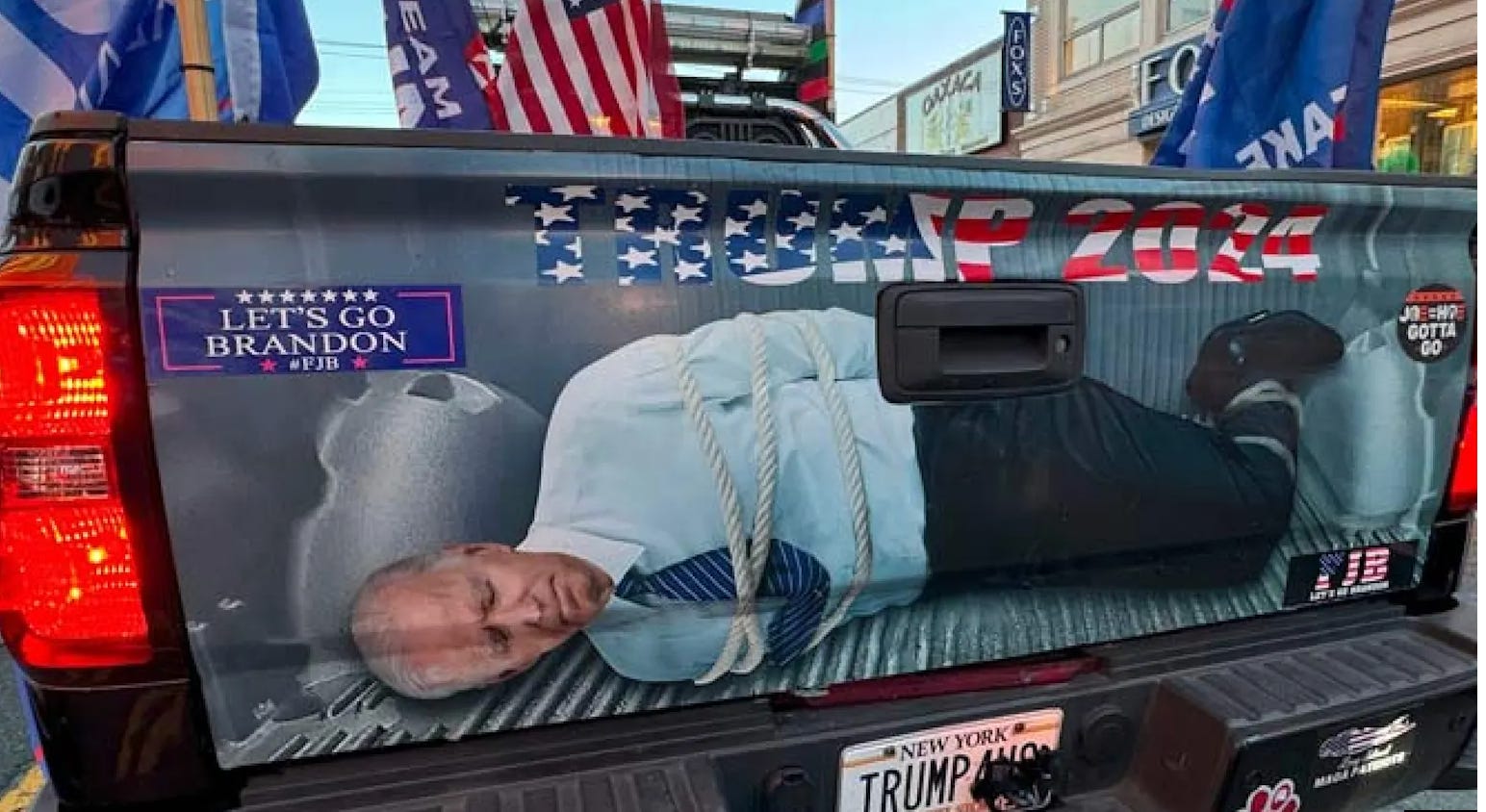
I summarize some of this intense activity of re-education to violence in this 2024 essay, which remains the most-read Lucid post to date. The present essay can be considered an update, with new examples surfacing almost every day.

Understanding the logic of violence for Trump and his collaborators is key to calling it out and helping our fellow Americans understand the stakes of letting violence become an integral “tool of rule,” as has been the case in authoritarian states going back to Mussolini’s dictatorship. It is a process of shifting a national culture and values system, as this X post makes clear.
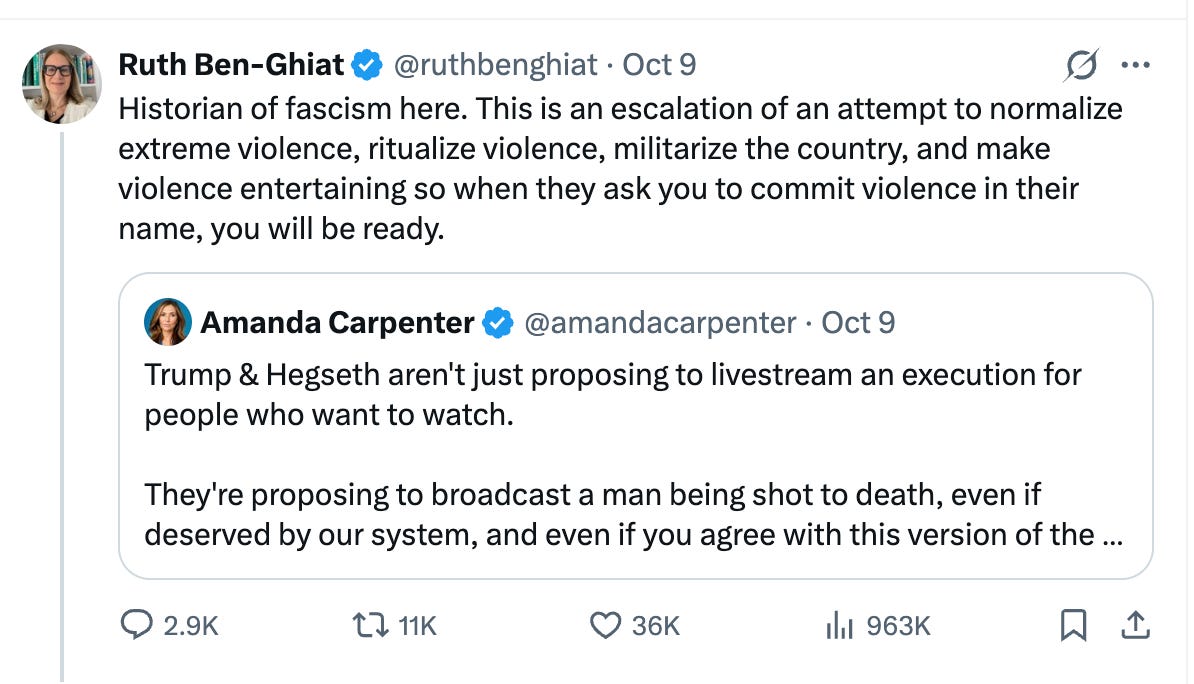
Frighteningly clear.
Ruth, could you please address this: a poll stated just 35 % of independents are “leaning” towards Democrats leaving 65 % undecided. That voter block is now 125 million per CNN - substantially larger than the other two voter blocks and yet even with the actions and threats you’ve just described and only 21 days until the election - the level of commitment to this country by that voter block is zero.
I’ve had no choice but to conclude they are colluding with Trump. How can that possibly be?
The violence is characteristic of a malignant narcissist. I'm beginning to believe that all dictators who lead authoritarian governments share the same psychopathy.