

This week's essay focuses on the Philippines, which saw the erosion of its own democracy under strongman Rodrigo Duterte, and now will be further jeopardized by the return of the family of former dictator Ferdinand Marcos to office. Click here to read my interview with U.S.-based Filipino academic Vicente Rafael about Duterte and Marcos-nostalgia.
____________________
In February 1986, Imelda Marcos, wife of Filipino dictator Ferdinand Marcos, hosted a lavish dinner at the Malacañang presidential palace for employees of the government agency responsible for investigating election fraud allegations in Manila. It was three days after the snap election Marcos had staged to save a regime plagued by a sagging economy and public disaffection with his corruption and brutality.
To ensure that the election would go his way, Marcos had hired dictator whisperer-lobbyists Roger Stone and Paul Manafort and paid millions to Filipino thugs, politicians, and journalists. Yet the opposition candidate Cory Aquino, the popular wife of assassinated anti-Marcos lawyer Benigno Aquino, disputed Marcos's victory, citing fraud and violence at the ballot box.
Imelda hoped that the 55 election investigators who each received envelopes of cash together with their dinner entrees would fix the situation. Instead, a grassroots uprising (the People Power Revolution) forced the Marcos family out of office. The dictator and his family fled to the United States, where Ferdinand Marcos died in 1989.
Imelda's payoffs and myriad other episodes of corruption during the regime risk being consigned to oblivion with the triumphal return of the Marcos family to the presidency. The dictator's son, Bongbong, running with outgoing strongman Rodrigo Duterte's daughter Sara as vice president, pulled off a strong victory in the May 9 election, receiving twice as many votes as the leading opposition candidate, Leni Robredo, who is the current vice president (31 million vs 14.8 million).
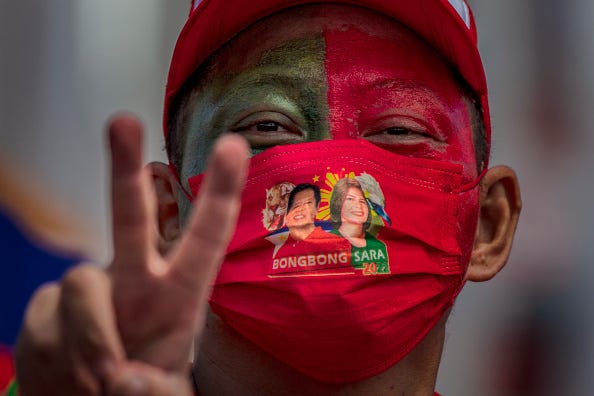
How do we account for the enduring popularity of a family that placed the Philippines under martial law, created a kleptocracy, and had critics of the regime jailed and killed?
When a dictator goes into exile, it can be difficult for his followers to find closure. His personality cult does not disappear, but survives in a state of suspended animation, with the most fervent hoping for his return.
In the case of Marcos, the creation of a political dynasty to continue his legacy was key, as was the decision to allow the family to repatriate to the Philippines just two years after the dictator's death. Bongbong entered politics, becoming a governor and a senator, with the power to advance a mythical narrative about the "efficiency" and "calm" his father created by maintaining martial law.
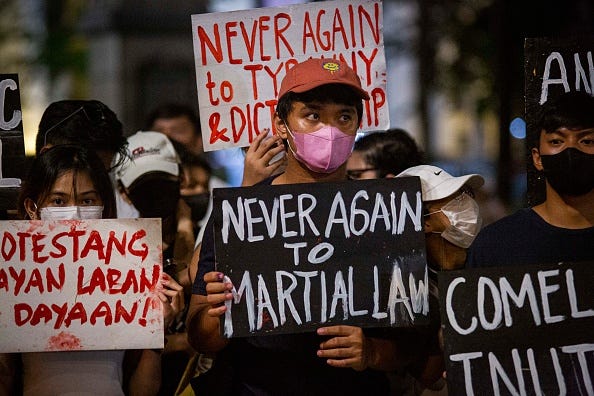
This reputational whitewash operation intensified during the 2022 election campaign. The Marcos camp unleashed a highly effective stream of disinformation. Videos posted on YouTube, and then shared on Facebook and other sites by followers, depicted martial law as a "golden age" of crime-free prosperity and engaged in negative messaging about Robredo.
The limited judicial reckoning the Marcos family faced for their immense corruption and violence also created the conditions for their return. A ledger listing Marcos bribes and payoffs, including for state killers (such as 1 million pesos to the killer of Evelio Javier, the anti-Marcos Governor of Antique province who was assassinated in February 1986) helped to convict Imelda Marcos of corruption. Yet she was deemed too old to serve prison time, and continued to have political influence. Nor did Bongbong’s conviction for failure to pay taxes in the 1980s stop his political career or lessen his popularity.
That's not unusual in the authoritarian world, where getting away with crime is a badge of honor. Duterte knows that well. The normalization and exaltation of violence during his own presidency likely helped Filipinos to accept a family with much blood on its hands.
That Marcos Jr. and Duterte Jr. lean in to this history of repression is suggested by Bongbong’s plan to hold a campaign event on the site where Javier was gunned down. He backed down due to public outcry, but Marcos Jr. celebrate Marcos Sr.’s murder was a typical authoritarian move.
The return of the Marcos family to power is another example of how illiberal leaders depend on the falsification and burial of history to manipulate belief in the present, flooding us with propaganda designed to atrophy our critical faculties. As Javier’s son, Gideon Javier, told me, disinformation, poor education, and the golden haze of nostalgia that keeps the Marcos brand alive means that "the Philippines' ability to remain a liberal democracy has become truly imperiled. I cannot digest the inhumanity of an entire nation of 112 million people condemned to such a fate."
Trump is in the mold of Bongbong and Sara, who have come back to power after his family's detailed history of crime, corruption and deadly repression. Like Bongbong and his father, Trump so far is getting away with his crimes and corruption and he is also getting lots of help from the usual right wing politicians and media outlets like FNC that constantly bombard millions of loyal listeners in the base with disinformation and propaganda including vile talk of replacing white people with immigrants so whites lose their political power. The myth of making America great again speaks directly to this white racial anxiety. And to insure a win, Trump is purging out RHINOs and replacing them with his loyalists who will zealously subvert democracy on the state and federal level to help him steal a Presidential election in 2024. Its a slow moving coup.
Democracy is becoming another word like liberal that’s losing its meaning. If one looks at the nations characterized as Democratic, one sees that the majority deprives their people of agency, that the will and well-being is ignored as a rule. In other words, they’re not actually democratic outside of appearances. Even here, we have an extractive economy where a large minority of full time workers are denied a living wage, that the dominant response to a global pandemic is to oppose responding to it, and the highest court in the land acts predominantly like a repressive authoritarian junta.