


I’m pleased to publish this guest post by Casey Michel. He is a journalist who writes on corruption and illicit finance, and is the author of American Kleptocracy, Foreign Agents, and his 2026 book United States of Oligarchy: How America’s Wealthiest Ally with Dictators, Weaken the U.S., and Destroy Democracy. He is a senior nonresident fellow on corruption at the Center for International Policy. This post draws on that recent book and adds some updated reflections.
On the subject of inequality and its harm to democracy, see also my recent conversation with Nobel Prize-winning economist Daron Acemoglu. And on October 16, our Q&A guest will be Isabella Weber, who will discuss her new book Anti-Fascist Economics. If you’d like to join these stimulating conversations, you can sign up as paying or upgrade to paid here:
_____________
For many Americans, there’s a growing awareness that economic inequality in the U.S. has spiraled beyond any kind of control, and even beyond any kind of precedent. This has been especially true in the 2020s, as the numbers on economic inequality in the U.S. grew more and more bleak.
In 2020, for instance, the RAND Corporation issued a new study focused on income (rather than just wealth) inequality. And the numbers couldn’t have been starker. As authors Kathryn Edwards and Carter Price wrote, starting in 1975, incomes for the bottom 90 percent of Americans began stagnating, largely unmoved for the half-century since. But incomes for the top 1 percent more than quadrupled. Had things instead remained steady – had incomes continued growing at similar rates to the decades previous to 1975 – the bottom 90 percent of Americans would have “collectively taken home $2.5 trillion more in income,” in 2018 alone. Last year, the researchers updated their estimates to $3.9 trillion – or a total of $79 trillion in income that could have gone toward the bottom 90 percent since 1975.Instead, that wealth had been sucked upward, pocketed by fewer and fewer Americans over the years.
But it wasn’t just that these forces had deflated America’s middle class, making life nastier, more brutish, and even shorter for many Americans, It was that, for the first time, political scientists finally began studying the links between economic inequality and democracy – and finding that the links between inequality and democratic decline were more obvious than any had ever assumed.
It’s not like folks couldn’t see a correlation; anyone following the news, watching dictatorship spread like a fungus as the world grew more and more unequal, could see those two forces proceeding simultaneously. But did one necessarily compel the other? Was there an actual relationship there? Or was it all simply coincidence?
One of the first to tackle the question head-on was Robert Andersen, a sociology professor at the University of Toronto. Surveying dozens of countries, Andersen tried to answer one question: did economic inequality really have a detrimental effect on democracy? Surveying dozens of countries, measuring both democratic support and spiraling inequality, the answer was unequivocal. Not only was there a direct linkage – but it was clearer, and much worse, than anyone ever thought.
Cutting through the jargon, Andersen’s conclusions were indisputable. Whereas most scholars had linked support for democracy to the overall wealth of a country – finding that the wealthier the nation, the greater the likelihood of supporting democracy – Andersen discovered that “income inequality matters much more.” Overall wealth was still important, but the economic disparity within a country was far more pertinent to that nation’s support for democracy. Democracy, as he wrote, has “less support in countries with high income inequality.” The more unequal a nation, the less the support for democracy, full-stop.
Andersen’s findings didn’t stop there. “There is increasing evidence that economic inequality plays a role in a whole array of attitudes and behaviors considered important to the health of democracy, including attitudes towards income inequality, social trust and tolerance, and participation in voluntary associations,” he continued.
“The general finding is that the more unequal a society, the less likely people are to be socially tolerant, to trust one another, to favor equality, and to participate in voluntary associations.”
In other words: As economic inequality takes off, nations will fray further and further, with cohesion collapsing and societies atomizing. As inequality grows, democracy implodes – and often slips into something far worse.
Other scholars have confirmed as much in the years since. In 2024, South Korean scholar Sang Kyung Lee determined that “where inequality is more severe, citizens in liberal democracies are more attracted to authoritarian leaders.” Around the same time, a pair of other researchers – the University of Chicago’s Susan Stokes and Tecnológico de Monterrey’s Eli Rau – backed up the findings even further. They tried to ascertain just how strong that relationship between democratic erosion and economic inequality truly was. And as they determined, the link between the two is “stunningly robust.” “The more unequal income distribution is in a democracy, the more at risk it is of electing a power-aggrandizing and norm-shredding head of government,” the two researchers wrote.
That is, as a society’s inequality balloons, the likelihood of electing a strongman – a figure who will seize the levers of power, demolishing his country’s democracy in the process – only grows. As the researchers confirmed, there was a direct relationship discovered between economic inequality and the rise of modern autocracy. Few other things, like how long the democracy had actually been around, mattered. “Even wealthy and longstanding democracies, like the United States, are vulnerable if they are highly unequal,” the authors wrote. “The larger the share of national income and wealth going to the top one percent and top 10 percent of the population, the more likely the democracy is to erode.
One question remained: Precisely why did such soaring inequality make residents of a specific nation less and less supportive of democracy? Unlike other researchers, Stokes and Rau tried to answer that question – or at least provide a range of likely theories for future researchers to hopefully tackle. As they noted, increased inequality contributes directly to increased polarization, which has been linked time and again to democratic decline and national fracture. Those on the wrong side of income inequality – those losing more and more, all while watching a country’s upper crust sprint away with a nation’s wealth – tend to gravitate toward the fringes on both ends of the political spectrum, searching out answers and proposing solutions that the more moderate center is incapable of providing.
This “pernicious polarization,” as political scientists have described it, is an endless spiral outward, until one party or political movement resorts to anti-democratic actions – coups, political persecution, exile, or worse – to cement their grip on power. Economic inequality, in other words, is the lubricant for the forces demolishing democracy.
And that’s only among the politically engaged. As Rau and Stokes also found, “public perceptions of unfairness in economic distributions and opportunities contribute to cynicism about the broader system, weakening people’s commitment to political norms and institutions.” The kind of unseen, unspoken forces gluing democratic societies together – respecting election outcomes, disapproving of political violence, a willingness to work together across the political aisle – hold only as long as voters believe in the ultimate fairness of their political and economic systems. But once that perception of fairness goes, so goes the belief that democracy is worth saving.
Is that any surprise? If a democratic system resulted only in an elite who dominated a nation’s economic wealth, all while selling themselves to foreign patrons in the process, what appeal would democracy still have? Working longer hours, sacrificing time with family and friends, foregoing vacations or recreation or any kind of relaxation, all just to tread water – even as the richest in a given nation grow ever-richer, lifting their wealth beyond any kind of democratic checks, squirreling it away for themselves and their children and their grandchildren, forevermore – why wouldn’t that lead to grievance? Why wouldn’t that lead to retribution? Why wouldn’t that lead to a desire to toss democracy to the side, and replace it with something else, damn the consequences?
Why wouldn’t a democracy resulting in this kind of crescendoing economic inequality lead – invariably, time and time again – directly to the collapse of that democracy? Is that where we’ve always been headed, ever since inequality first began taking off decades ago, and ever since the oligarchs re-emerged once more, crawling back to the top of America’s economic pyramid and suffocating the chances and the democratic desires of the rest of us?
Thankfully, we’re not there yet. And even though we’ve seen declining support for democracy across the board in the U.S., we’ve also seen something else: pushback. Over the past few years, and especially over the past 18 months, we’ve seen a concerted effort to put the kinds of anti-corruption and anti-inequality policies necessary to tackle all of this inequality front and center for Democratic politics.
Across the country, wealth taxes – the kinds that would explicitly target those wealthiest individuals, hiding their money from tax authorities and investigators alike – have suddenly become one of the most popular topics among those focused on wealth inequality and affordability. Cleaving off the upper-most wealth for the upper-most oligarchs, these wealth taxes would single-handedly shrink America’s yawning wealth inequality, potentially for good.
The last time the US lived through something comparable to this Age of Oligarchy was the Gilded Age, when a similar set of men swaggered over American democracy, using their connections and their riches to drag and direct American policy for their own ends. That era birthed sprawling wealth inequality, decimating American populations and American politics alike.
But it also gave birth to a combination of muckraking journalists, anti-inequality politicians, and figures like Teddy Roosevelt, all congealing into a force that, in time, brought that original caste of oligarchs to their knees. They implemented new regulations. They oversaw new investigations. And, yes, they introduced new taxes, including both income and inheritance taxes, which cut off a rising aristocracy that was then threatening to take over American politics entirely.
It was a period we now know as the Progressive Era. And it was the perfect antidote to that first era of robber barons attempting to mangle and manipulate American politics – an era that now most resembles our own. Now, with the oligarchs circling our democracy like a committee of vultures, it’s time for another Progressive Era to rise. Because we know what happens if it doesn’t – and what’s at stake for this democracy that these oligarchs and their hangers-on are now trying to dismantle.
As Teddy Roosevelt himself said, America “had come to the stage where for our people what was needed was a real democracy; and of all forms of tyranny the least attractive and the most vulgar is the tyranny of mere wealth, the tyranny of a plutocracy.” He was right then. And he’s right now. We know what the alternative is – and also what needs to be done to stave off the future that the oligarchs want, and that this world of wealth inequality will lead to if we let it.
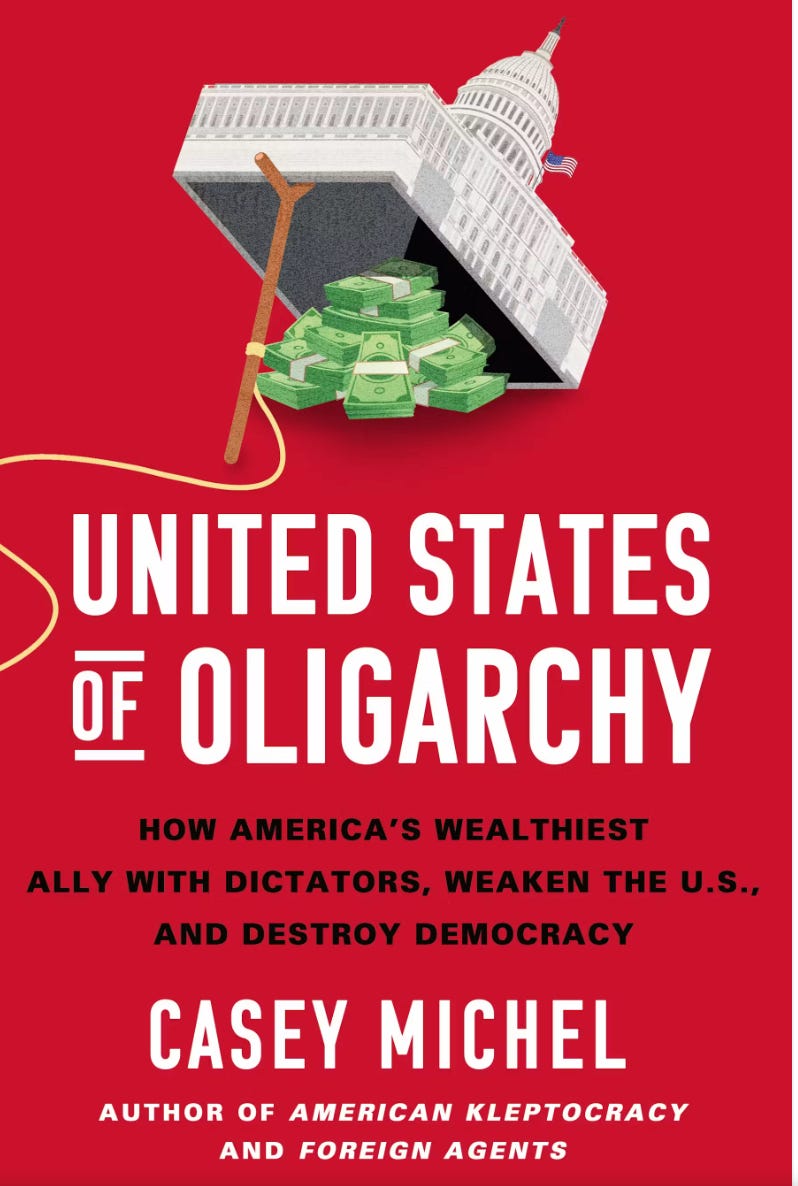
From UNITED STATES OF OLIGARCHY: How America’s Wealthiest Ally with Dictators, Weaken the U.S., and Destroy Democracy by Casey Michel. Copyright © 2026 by the author and reprinted by permission of St. Martin’s Publishing Group.
Great piece, most illuminating. Thanks for joining up the dots.
As the minister of a progressive congregation that has taught progressive sexuality education for over 50 years (called Our Whole Lives), one that has been inclusive of all people and identities, and one that talks about consent and harm, I've longed for a similar curriculum around the money and economics that includes values, ethics, and is written beyond understanding of its effects on the individual but its collective effects on all of us. Originally in the early 70s the curriculum was designed for junior high students. But it began by educating the parents about what their children would be learning. So both the students and parents learned and could potentially (and often did) talk about what they got from the classes. When it was revised year laters curriculum expanded to lower elementary, upper elementary, high school, college, young adult, adult, and senior citizens. I can't help but imagine what a similar curriculum could do economics and money. (I suspect Robert Reich could envision a curriculum, if he hasn't already, in a few days' time.) Ruth could even contribute on some level from her chapter on virility and gender, which could be it's own 3-part series. I hope I can make it, Sundays are bad for me but the topic is inviting.